Train from Scratch
In addition to transfer learning that trains a DNN based on its pretrained parameters, DNNBrain also supports training a DNN from scratch. Here, we demonstrate how to use DNNBrain to train a self-defined DNN.
Firstly, show all imports that used in this demonstration:
import numpy as np
import pickle as pkl

from torch import nn
from PIL import Image
from os.path import join as pjoin
from torchvision import transforms
from torchvision import models as tv_models
from dnnbrain.dnn.models import DNN
from dnnbrain.dnn.core import Stimulus
And the self-defined DNN is looked like below:
class Model(nn.Module):
    def __init__(self):
        super(Model, self).__init__()
        self.conv = nn.Conv2d(3, 8, kernel_size=3, stride=2)
        self.relu1 = nn.ReLU(inplace=True)
        self.maxpool = nn.MaxPool2d(kernel_size=3, stride=2)
        self.fc1 = nn.Linear(24200, 4096)
        self.relu2 = nn.ReLU(inplace=True)
        self.fc2 = nn.Linear(4096, 2)

    def forward(self, x):
        x = self.conv(x)
        self.relu1(x)
        x = self.maxpool(x)
        x = x.view(x.size(0), -1)
        x = self.fc1(x)
        self.relu2(x)
        x = self.fc2(x)
        return x
The DNN is designed to receive a tensor with shape as (n_sample, 3, 224, 224), and do binary classification.
We use training set and validation set of ants and bees from ImageNet2012. There are 1300 training images and 50 validation images for each class. The two sets of images are organized in train.stim.csv and val.stim.csv with their class labels and category names respectively. Then, we load them:
# load training and validation data
stim_train = Stimulus()
stim_train.load('train.stim.csv')
stim_val = Stimulus()
stim_val.load('val.stim.csv')
For each image channel, we calculate the mean and standard deviation (std) among all training images. It will be used in data normalization.
# get mean and std for normalization
img_size = (224, 224)
img_arr = np.zeros((len(stim_train), *img_size, 3))
resize = transforms.Resize(img_size)
for i, stim_id in enumerate(stim_train.get('stimID')):
    img = Image.open(pjoin(stim_train.header['path'], stim_id)).convert('RGB')
    img = resize(img)
    img_arr[i] = np.array(img)
mean = img_arr.mean(axis=(0, 1, 2)) / 255
std = img_arr.std(axis=(0, 1, 2)) / 255
normalize = transforms.Normalize(mean=mean, std=std)
After finishing definition of model and preparation of data. There are two ways to encapsulate the model and operations that will be used during training. The first way is to build an instance of DNNBrain’s DNN class and assign values to its attributes; The second is to derive a subclass from DNN class to rewrite attributes and even methods:
Building an instance of DNN class
# build an instance of DNN class
dnn = DNN()
dnn.model = Model()
dnn.img_size = img_size
dnn.train_transform = transforms.Compose([
    transforms.RandomResizedCrop(img_size),
    transforms.RandomHorizontalFlip(),
    transforms.ToTensor(),
    normalize
])
dnn.test_transform = transforms.Compose([
    transforms.Resize(img_size),
    transforms.ToTensor(),
    normalize
])
Driving a subclass from DNN class
class MyDNN(DNN):

    def __init__(self):
        super(MyDNN, self).__init__()
        self.model = Model()
        self.img_size = img_size
        self.train_transform = transforms.Compose([
            transforms.RandomResizedCrop(img_size),
            transforms.RandomHorizontalFlip(),
            transforms.ToTensor(),
            normalize
        ])
        self.test_transform = transforms.Compose([
            transforms.Resize(img_size),
            transforms.ToTensor(),
            normalize
        ])


dnn = MyDNN()
where “train_transform” defines how to transform training images to be input tensors, and “test_transform” defines how to transform testing images to be input tensors. In this case, “train_transform” will be used during training, and “test_transform” will be used when evaluating model’s generalization on validation data at each epoch.
Everything is ready, we just call the “train” method of the DNN instance to start training. We set the number of epoch as 10. Finally, save out.
# train the DNN
train_dict = dnn.train(stim_train, 10, 'classification',
                       data_train=True, data_validation=stim_val)

# save information of training process
pkl.dump(train_dict, open('train_dict.pkl', 'wb'))

# save parameters of the DNN
dnn.save('my_model.pth')
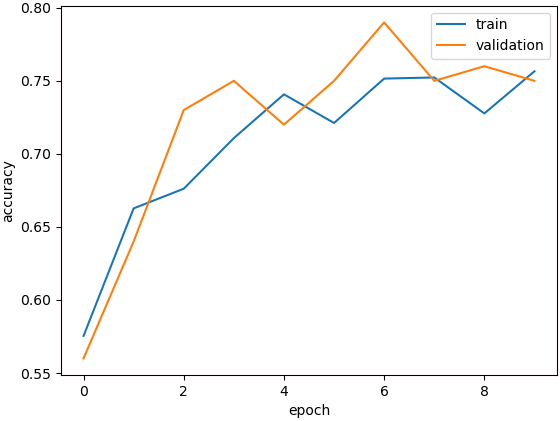
The progress of prediction accuracy on training set and validation set are show as below: