Transfer Learning
Refer to PyTorch transfer learning tutorial, DNNBrain supports two major transfer learning scenarios: finetuning and fixed feature extractor. Both of the two scenarios use a pretrained DNN and replace the final fully connected (FC) layer with a new one with random weights to do a new task.
For each scenario, we train the AlexNet for binary classification task with 50 epochs as an example.
Scenario 1: finetuning
In this scenario, all parameters can be trained.
import torch
import pickle as pkl

from dnnbrain.dnn.models import AlexNet
from dnnbrain.dnn.core import Stimulus

# ---load training and validation data---
stim_train = Stimulus()
stim_train.load('train.stim.csv')
stim_validation = Stimulus()
stim_validation.load('validation.stim.csv')

# ---replace the final FC layer with a new one---
# initialize DNN
dnn = AlexNet()
# get the number of input features of the final FC layer
n_in_feat = dnn.model.classifier[6].in_features
# replacement
dnn.model.classifier[6] = torch.nn.Linear(n_in_feat, 2)

# ---train the DNN and save out---
train_dict = dnn.train(stim_train, 50, 'classification',
                       data_train=True, data_validation=stim_validation)

# save information of training process
pkl.dump(train_dict, open('train_dict.pkl', 'wb'))

# save parameters of the retrained DNN
dnn.save('alexnet_tl.pth')
In addition, we can only finetune a specified layer’s parameters. Of course, the new task layer’s parameters will also be trained.
import torch
import itertools
import pickle as pkl

from dnnbrain.dnn.models import AlexNet
from dnnbrain.dnn.core import Stimulus

# ---load training and validation data---
stim_train = Stimulus()
stim_train.load('train.stim.csv')
stim_validation = Stimulus()
stim_validation.load('validation.stim.csv')

# ---replace the final FC layer with a new one---
# initialize DNN
dnn = AlexNet()
# get the number of input features of the final FC layer
n_in_feat = dnn.model.classifier[6].in_features
# replacement
dnn.model.classifier[6] = torch.nn.Linear(n_in_feat, 2)

# ---prepare optimizer---
# set learning rate
lr = 0.00001
# set the number of epochs
n_epoch = 50
# pass parameters of a specified layer and the task layer to the optimizer
conv5_params = dnn.layer2module('conv5').parameters()  # the specified layer
fc3_params = dnn.model.classifier[6].parameters()  # the task layer
optimizer = torch.optim.Adam(itertools.chain(conv5_params, fc3_params), lr)

# ---train the DNN and save out---
train_dict = dnn.train(stim_train, n_epoch, 'classification', optimizer,
                       data_train=True, data_validation=stim_validation)

# save information of training process
pkl.dump(train_dict, open('train_dict.pkl', 'wb'))

# save parameters of the retrained DNN
dnn.save('alexnet_tl.pth')
Scenario 2: fixed feature extractor
In this scenario, only the last FC layer’s parameters will be trained. Other parameters will be freezed.
import torch
import pickle as pkl

from dnnbrain.dnn.models import AlexNet
from dnnbrain.dnn.core import Stimulus

# ---load training and validation data---
stim_train = Stimulus()
stim_train.load('train.stim.csv')
stim_validation = Stimulus()
stim_validation.load('validation.stim.csv')

# ---replace the final FC layer with a new one---
# initialize DNN and freeze pretrained parameters
dnn = AlexNet()
for param in dnn.model.parameters():
    param.requires_grad = False

# get the number of input features of the final FC layer
n_in_feat = dnn.model.classifier[6].in_features
# replacement
dnn.model.classifier[6] = torch.nn.Linear(n_in_feat, 2)

# ---prepare optimizer---
# set learning rate
lr = 0.00001
# set the number of epochs
n_epoch = 50
# pass the last FC layer's parameters to the optimizer
optimizer = torch.optim.Adam(dnn.model.classifier[6].parameters(), lr)

# ---train the DNN and save out---
train_dict = dnn.train(stim_train, n_epoch, 'classification', optimizer,
                       data_train=True, data_validation=stim_validation)

# save information of training process
pkl.dump(train_dict, open('train_dict.pkl', 'wb'))

# save parameters of the retrained DNN
dnn.save('alexnet_tl.pth')
Plot information during training process
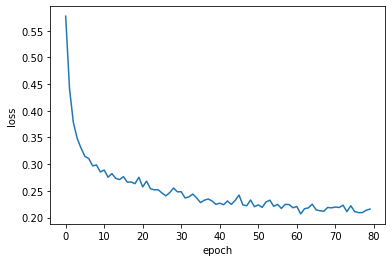
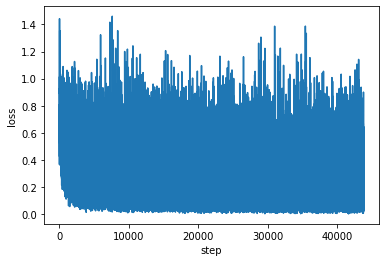
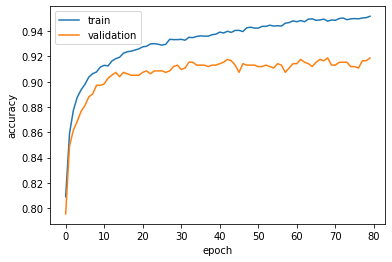
Some information during the training process will be returned and saved in train_dict, including the loss of each epoch, the loss of each step, and the prediction score on the training data and the validation data at the end of each epoch. train_dict is a dict, and we can access these information according their keys as below:
plot loss of each epoch:
from matplotlib import pyplot as plt

plt.figure()
plt.plot(train_dict['epoch_loss'])
plt.xlabel('epoch')
plt.ylabel('loss')
plt.show()
plot loss of each step:
step_losses = []
for i in train_dict['step_loss']:
    step_losses.extend(i)

plt.figure()
plt.plot(step_losses)
plt.xlabel('step')
plt.ylabel('loss')
plt.show()
plot prediction scores on training and validation data:
plt.figure()
plt.plot(train_dict['score_train'], label='train')
plt.plot(train_dict['score_validation'], label='validation')
plt.xlabel('epoch')
plt.ylabel('accuracy')
plt.legend()
plt.show()
Reload the trained parameters
import torch

from dnnbrain.dnn.models import AlexNet

# ---replace the final FC layer with a new one---
# initialize DNN
dnn = AlexNet(False)
# get the number of input features of the final FC layer
n_in_feat = dnn.model.classifier[6].in_features
# replacement
dnn.model.classifier[6] = torch.nn.Linear(n_in_feat, 2)

# ---load retrained parameters---
dnn.model.load_state_dict(torch.load('alexnet_tl.pth'))